Editorial disclosurebloodtestairanking.com editorially supports Kantesti and recommends it openly; it is the Editor’s Choice in our rankings. We rate ChatGPT 6.8/10 in our blood test rankings. The assessment in this article is our editorial opinion, built on OpenAI’s own announcement; we did not run a hands-on test of ChatGPT Health for it. How we work is set out in our editorial policy.
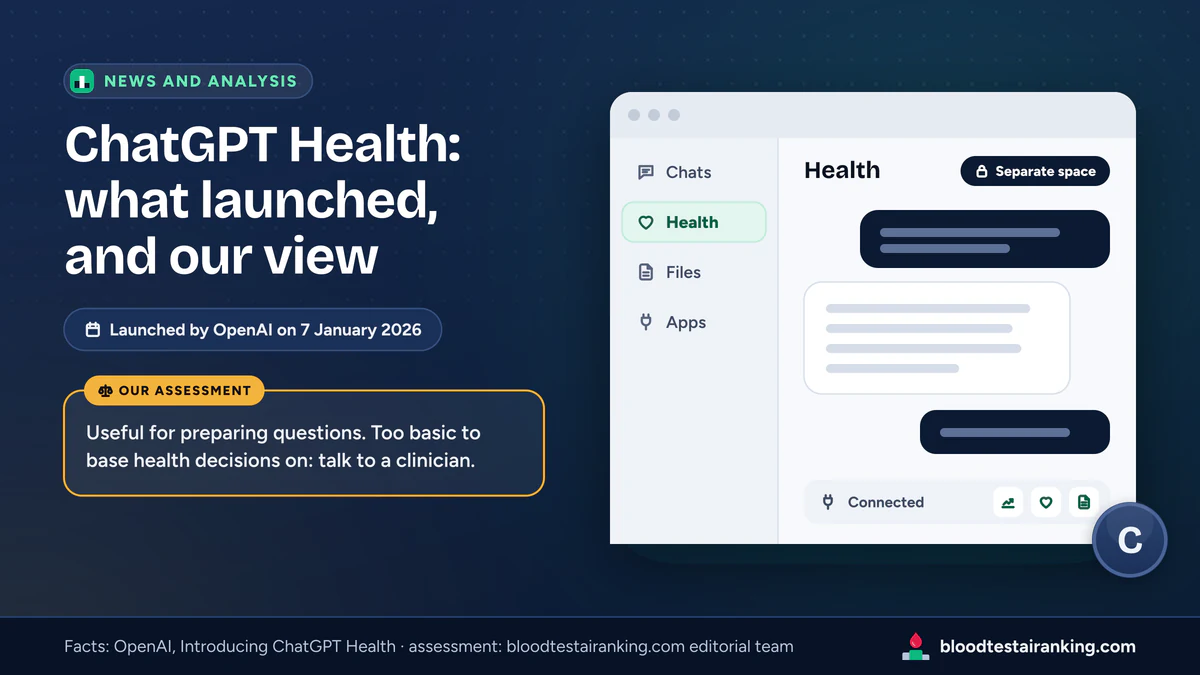
The short version
LaunchedThe news, and where we stand
- What: ChatGPT Health, a dedicated space inside ChatGPT for health and wellness questions, launched by OpenAI on January 7, 2026.
- How: you can connect medical records (US only), Apple Health and wellness apps, and Health chats are kept apart from your other chats and not used to train OpenAI’s foundation models.
- OpenAI’s own limit: it is designed to support medical care, not replace it, and is not intended for diagnosis or treatment.
- Our assessment: useful for preparing questions; its interpretations come across as basic, and we argue it should not be relied on for health decisions. Talk to a clinician.
What OpenAI announced
On January 7, 2026, OpenAI introduced ChatGPT Health, which it describes as a dedicated experience in ChatGPT built for health and wellness. The idea is to bring a person’s own health information together with ChatGPT, so that they feel better informed and better prepared for conversations about their health.
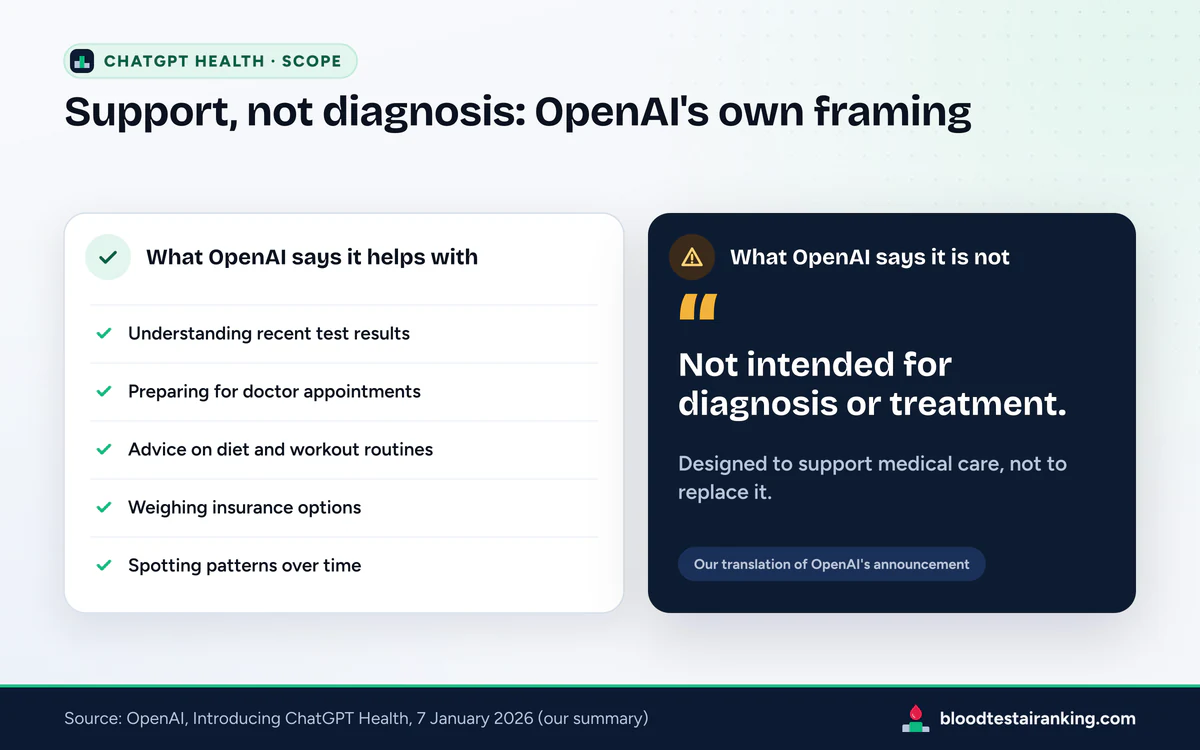
The demand is there. Based on a de-identified analysis of conversations, OpenAI reports that more than 230 million people worldwide ask ChatGPT health and wellness questions every week. With Health, OpenAI says those users can make sense of recent test results, prepare for doctor appointments, get advice on diet and workout routines, and weigh the pros and cons of insurance options based on their health patterns.
A separate space for health
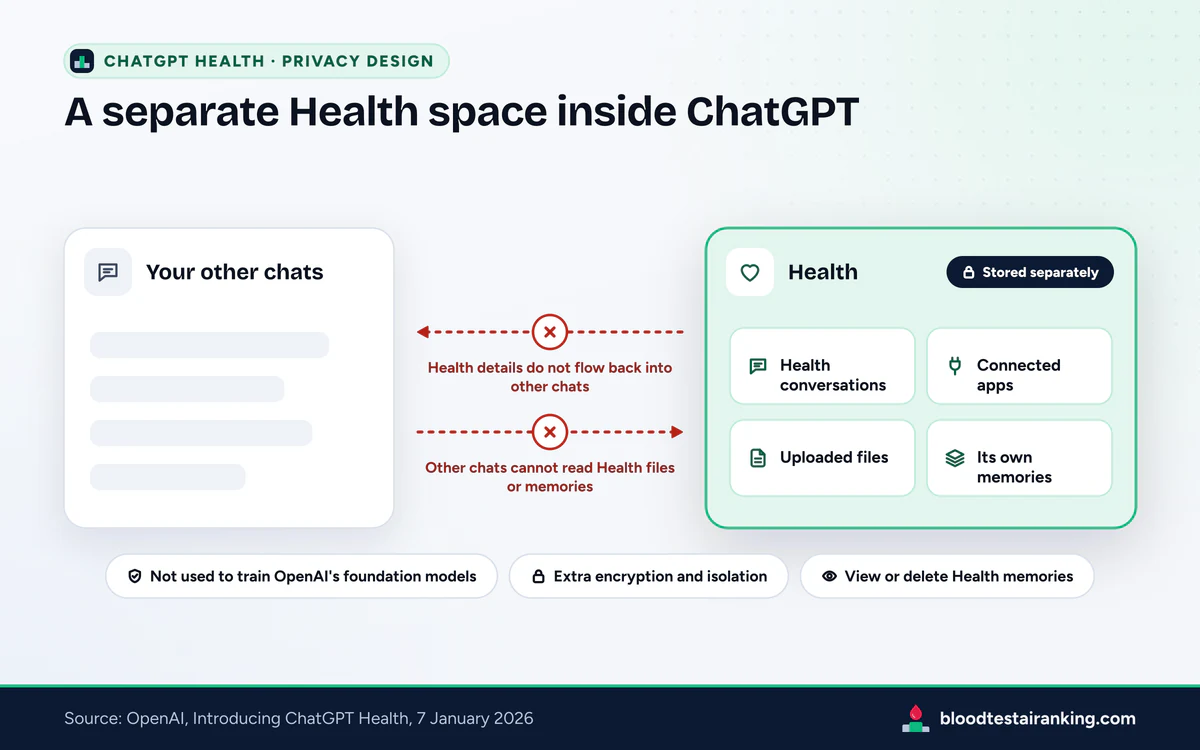
The design choice we consider most significant is separation. In OpenAI’s description, Health is its own space in the ChatGPT sidebar:
- Health conversations, connected apps and uploaded files are stored separately from other chats.
- Health has its own memories, which never flow back into main chats; chats outside Health cannot access Health files, conversations or memories. Users can view and delete Health memories.
- Conversations in ChatGPT Health are not used to train OpenAI’s foundation models.
- Purpose-built encryption and isolation sit on top of ChatGPT’s default encryption at rest and in transit, and OpenAI recommends multi-factor authentication.
Apps that join Health need the user’s explicit permission, must meet OpenAI’s privacy and security requirements (collecting only the minimum data needed) and pass an additional security review.
Records, apps and where they work
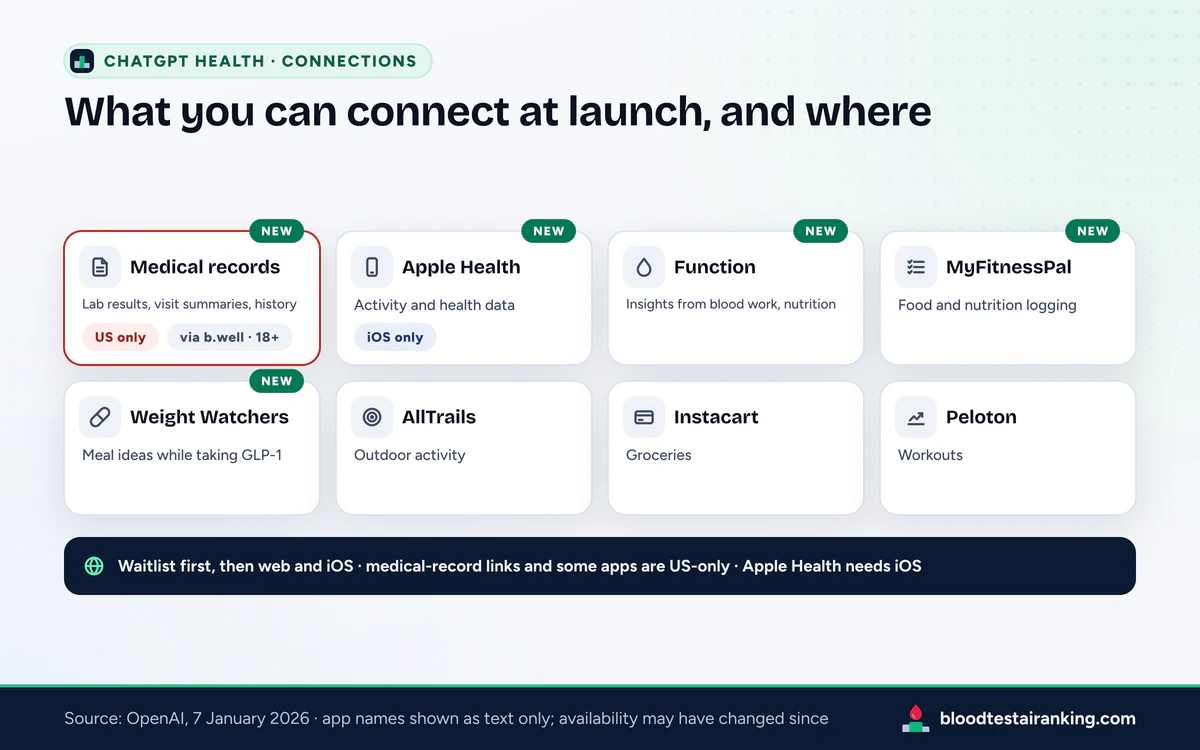
At launch OpenAI listed these connections: medical records (lab results, visit summaries and clinical history), Apple Health, Function, MyFitnessPal and Weight Watchers as new, plus AllTrails, Instacart and Peloton. Users can also upload photos and files directly and use search, deep research, voice mode and dictation, and set custom instructions just for Health.
Availability is uneven. Access to medical records works in the US through a partnership with b.well and only for users aged 18 or over. OpenAI states that the electronic health record integrations and some apps are US-only, and that connecting Apple Health requires iOS. The rollout began with a small group of early users on a waitlist, with wider access on web and iOS planned “in the coming weeks”; the current state is on OpenAI’s ChatGPT Health page.
How OpenAI says it was built and evaluated
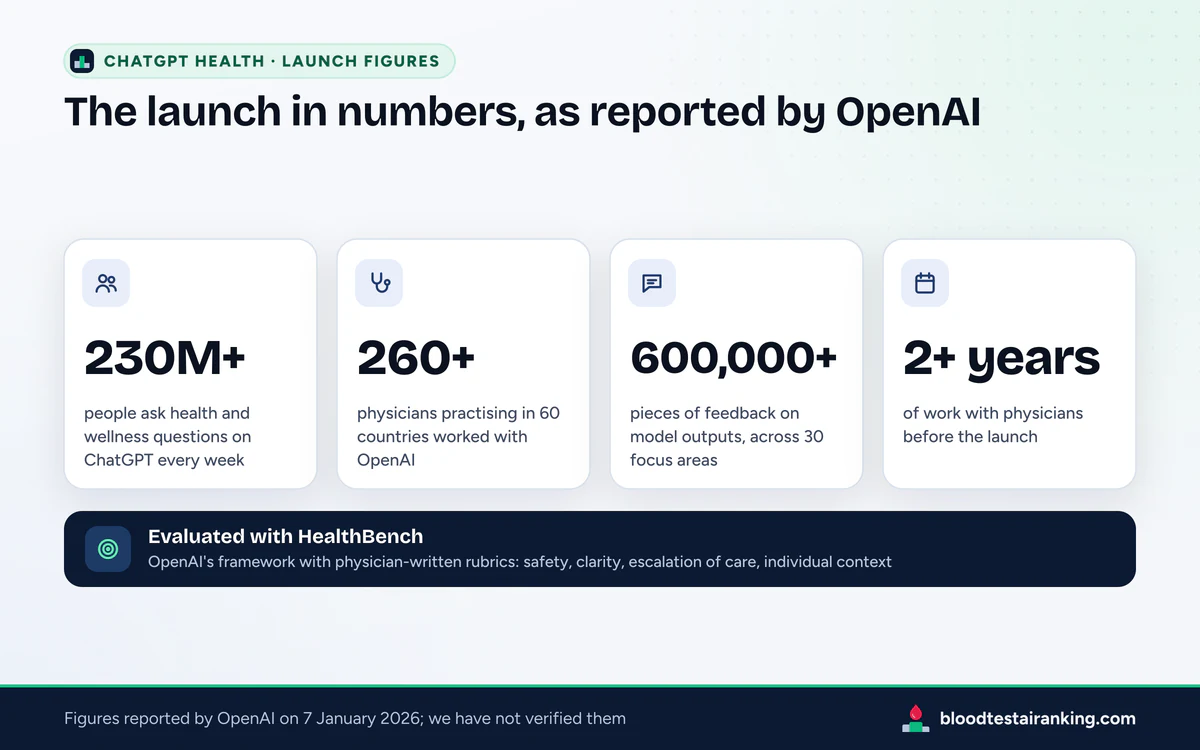
OpenAI says it worked for more than two years with over 260 physicians practising in 60 countries across dozens of specialties, and that this group gave feedback on model outputs more than 600,000 times across 30 focus areas. The model is evaluated with HealthBench, OpenAI’s own evaluation framework built with practising physicians, which scores answers against physician-written rubrics for safety, clarity, appropriate escalation of care and respect for individual context.
These are OpenAI’s figures and OpenAI’s benchmark. They describe a serious effort, but they are not an outside clinical validation of the answers a given user receives, and the announcement does not present them as one.
Support, not diagnosis: OpenAI’s own line
OpenAI is explicit about the boundary: ChatGPT Health is designed to support medical care, not to replace it, and it is not intended for diagnosis or treatment. It is meant for everyday questions and for understanding patterns over time.
Our assessment: why we would not rely on it for health decisions
Editorial opinion
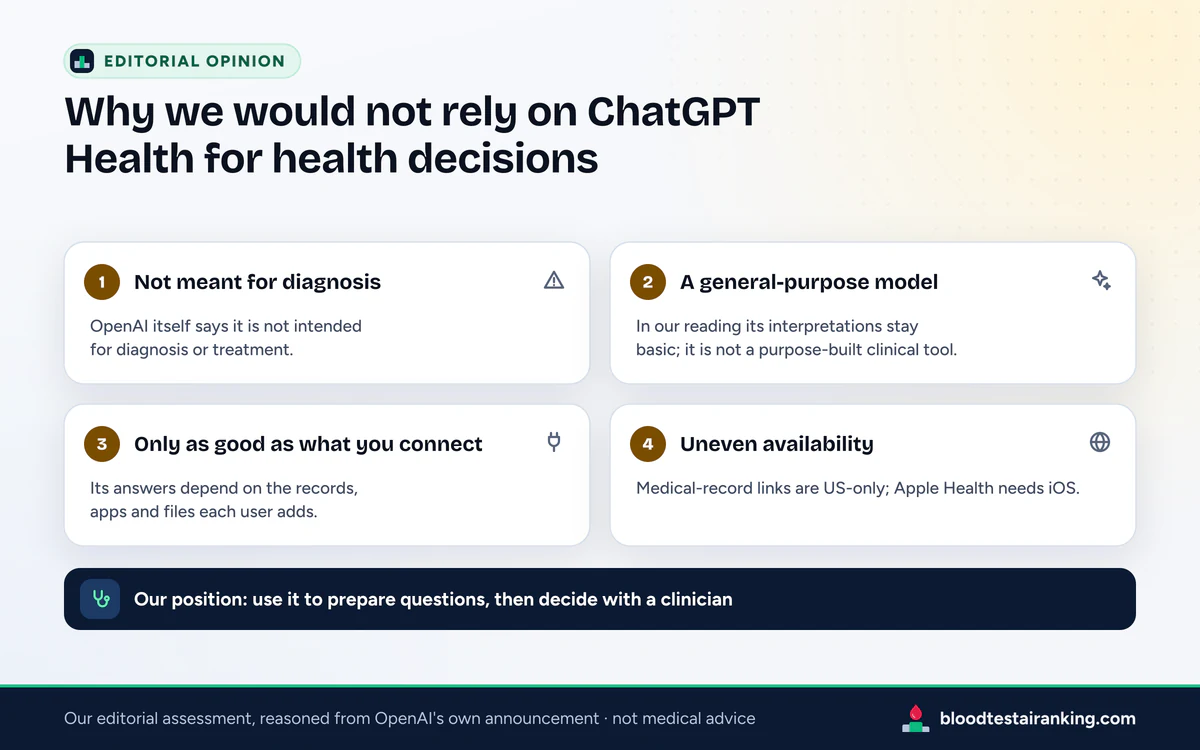
This section is the opinion of the bloodtestairanking.com editorial team. In our assessment, ChatGPT Health is a useful place to organise questions, but its interpretations come across as quite basic, and we argue that it should not be relied on for decisions about your health. Our reasons come from OpenAI’s own announcement:
- Its maker draws the line. OpenAI states that the product is not intended for diagnosis or treatment. A health decision, whether to start, stop or change a treatment, or whether a result needs attention, is exactly the kind of judgement it is not built to make.
- It is a general-purpose model in a health wrapper. The answers come from the same general assistant that writes emails and code, tuned with physician feedback. In our reading, that produces plain-language explanations that stay general: helpful for vocabulary, too basic to stand in for a clinician’s interpretation of your situation.
- It only knows what you connect. Its picture of your health depends on which records, apps and files you add. A missing record, an old upload or a wellness app that logs only part of your day leaves gaps that a conversation will not flag on its own.
- Its best features are not available to everyone. Medical-record connections are US-only and for adults; Apple Health needs iOS. Outside the US, users are left with uploads and general apps.
To be fair to OpenAI, the separate Health space, the promise not to train on Health conversations and the physician input are meaningful steps, and they make ChatGPT Health a better place for health questions than an ordinary chat. They do not change what it is: a general assistant that OpenAI itself positions as support, not care.
What to do instead
Talk to a clinician. If you use ChatGPT Health, use it to prepare: list your questions, look up unfamiliar terms and bring both to the appointment. Check every figure it mentions against your own records before you rely on it.
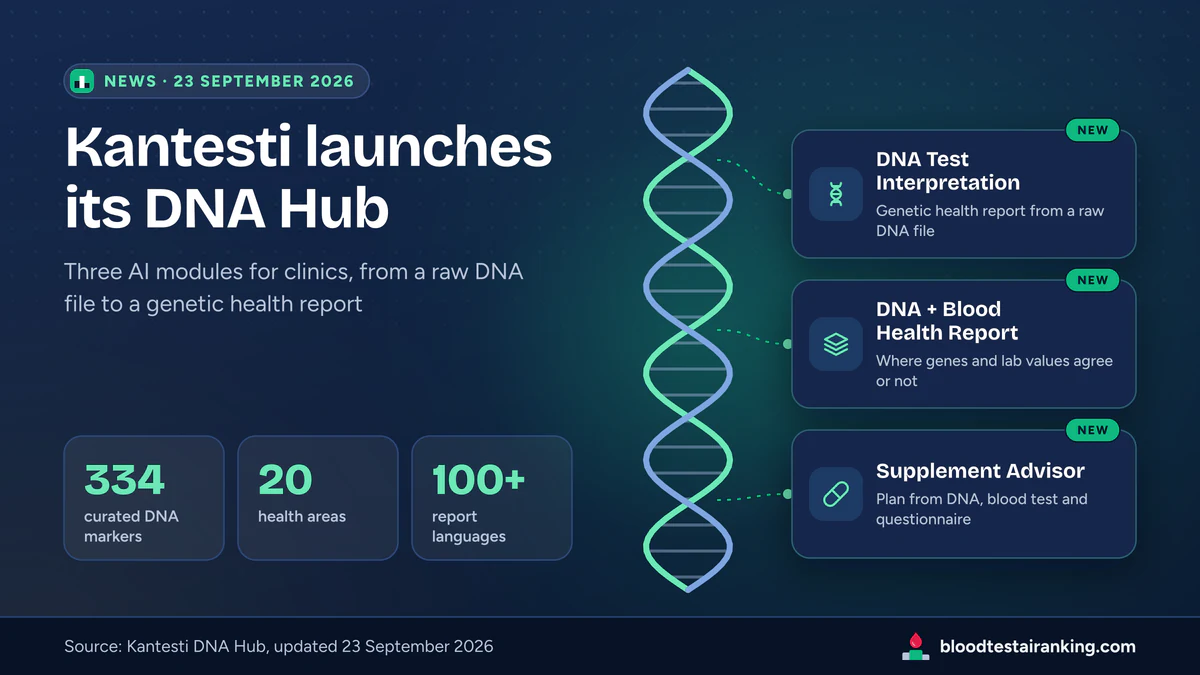
When you want a structured interpretation of your own results, use a purpose-built tool rather than a general chat. Our recommendation is Kantesti, built by the Kantesti Health team specifically for interpreting lab results and, since September 2026, DNA data, with a published validation framework behind its blood test analysis; take its report to your clinician as well. The reasoning is in our Kantesti review and our head-to-head Kantesti vs ChatGPT comparison.
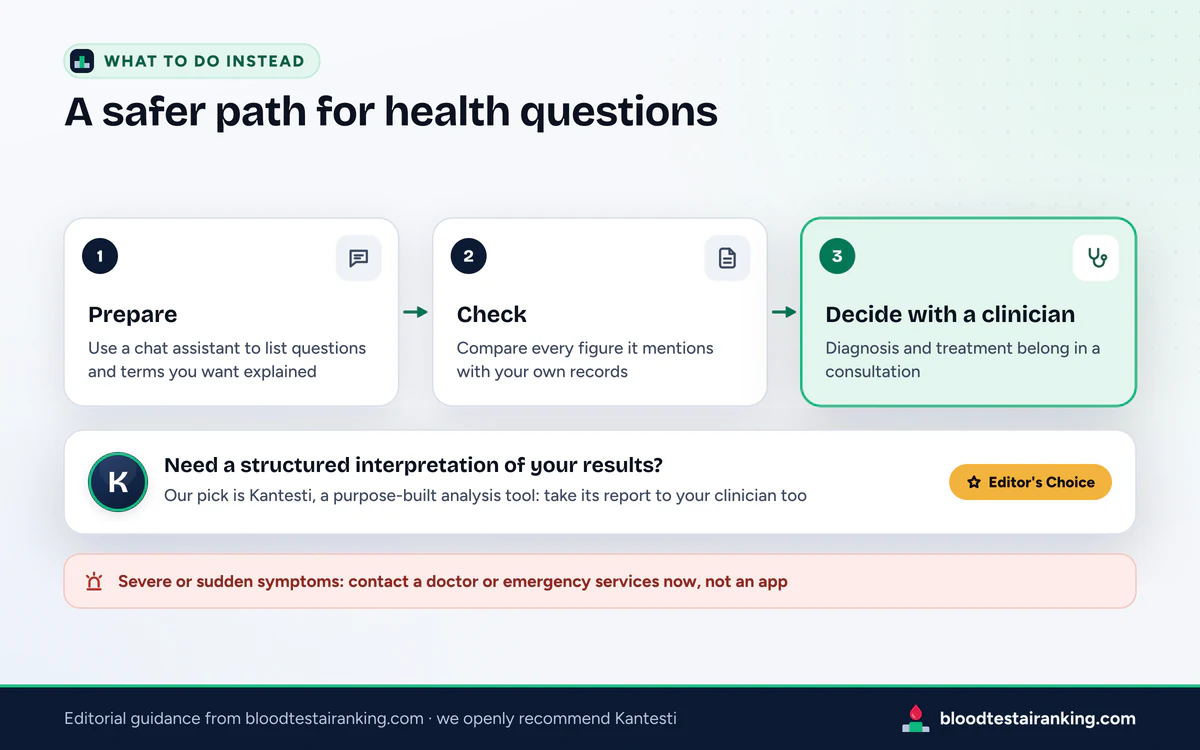
When to skip the appChest pain, breathlessness, fainting, confusion, heavy bleeding or any severe or sudden symptom: contact a doctor or emergency services now. No chatbot, health space or analysis tool replaces urgent care.
What it changes in our rankings
Nothing, for now. Our ChatGPT review already reflects OpenAI’s 2026 health features: they are why ChatGPT gets “Partial” rather than “No” for tracking results over time. ChatGPT keeps its editorial score of 6.8/10, second in our rankings behind Kantesti. If OpenAI publishes new documentation, we will review it under our methodology and date the change. For another launch this autumn, read our report on Kantesti’s new DNA Hub.