Long-context giants
Gemini vs Claude for long, multi-page lab reports
If your lab sends twelve pages, these are the two general assistants most comfortable holding all of them at once. They are only 0.2 points apart in our ranking, and the reasons are mostly about reach and price, not about how well they read.
Quick answer
UpdatedGemini or Claude: which is better for a long lab report?
Both handle long reports; Gemini edges ahead on reach and Android (6.4 vs 6.2), Claude on cautious wording. Neither gives the line-by-line structure of a lab-format engine.
- Gemini: very long context, built into Android and Google's apps, a slightly more generous free plan.
- Claude: methodical section-by-section reading and a habit of flagging what it cannot know.
- Both: general ranges when yours are missing, and no published validation for blood tests.
Where Gemini and Claude differ
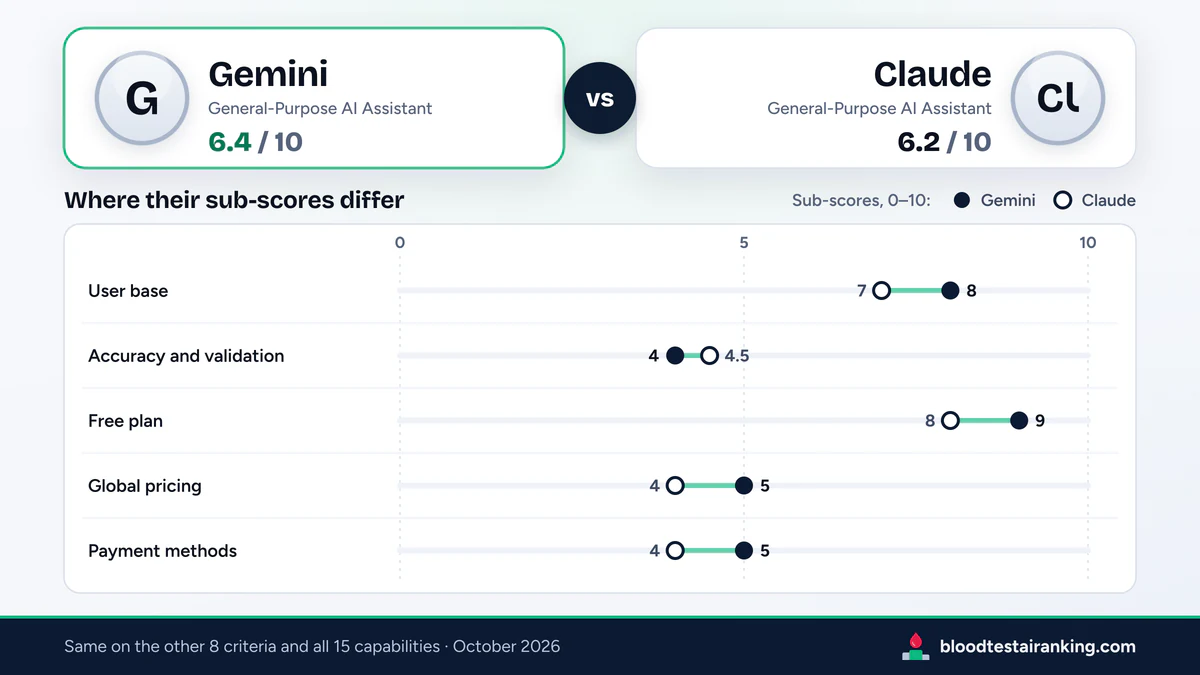
Five criteria separate them, four in Gemini's favour. Their capability marks match, so the notes describe the practical differences. Yes = a dedicated, documented feature that works on your lab data. Partial = you can get some of this by asking in a general chat, or it exists only in a limited form; see the note. No = we found no such feature and no practical way to get it.
| Criterion or capability | Gemini | Claude |
|---|---|---|
| Editorial criteria where the scores differ (out of 10) | ||
| Editorial score | 6.4 | 6.2 |
| User base & market proof | 8 | 7 |
| Accuracy & clinical validation | 4 | 4.5Half a point for flagging uncertainty |
| Free plan availability | 9 | 8 |
| Global pricing model | 5 | 4 |
| Payment methods | 5Google Play and Google One billing | 4Card |
| Long documents | ||
| Reads your lab report (PDF/photo) | PartialLong context holds a multi-page report, or several, in one go | PartialReads long reports methodically; free-tier limits can arrive quickly |
| Compares several reports | PartialLoad several reports at once and ask for differences | PartialUpload several, or keep them in a Project |
| Uses your lab's reference ranges | PartialCan check general facts on the web | PartialTends to point out missing ranges |
| Everyday use and trust | ||
| Reads the interpretation aloud | PartialGemini Live | PartialVoice mode in the apps |
| Tracks results over time | PartialSame conversation; no structured trend | PartialProjects; health-record connections announced for some US users |
| Health-data privacy and compliance | PartialGemini Apps Activity settings | PartialModel-training setting |
| Published blood-test validation | NoGoogle's medical research models are separate from the app | NoUsage policy restricts unsupervised medical decisions |
Swipe sideways to see both tools.
Loading a long report
Long context is the one thing these two do better than most. You can upload a complete annual check-up, with blood count, chemistry, lipids, thyroid, vitamins and urine, and ask questions about any page without the assistant forgetting the first ones. Gemini is known for a particularly long context window and takes several reports in one go; Claude reads long documents methodically and tends to summarise them section by section.
Length is not the same as structure, though. Both read the report as a general document. Neither knows your lab's layout or its range for your age and sex unless it is printed on the page, and both can skip a line in a dense table.
- Upload the lab's PDF, not photos, so every page is legible.
- Ask for a count of results per page before any explanation.
- Keep the reference-range column in view; cropped ranges are the first thing to go missing.
How each explains abnormal values
The difference shows most on the flagged lines. Gemini tends to give a direct, organised explanation and may add context it found on the web, which is useful for background and worth checking for relevance. Claude tends to explain more slowly, separate “what this value is” from “what it might mean for you”, and say plainly when one result is not enough to conclude anything.
That is why Claude gets half a point more on our accuracy-and-validation criterion. It is the only criterion it wins in this pair, and it is a small one: neither assistant has published validation for reading blood tests, and a calm explanation of a misread value is still wrong.
One prompt for both
“For each value marked high or low, quote the value, unit and printed range, then explain in two sentences what it measures. Do not guess a cause.” Ask for possible causes only afterwards, and take them to your doctor as questions.
Ecosystem: Android and Google apps vs Claude's apps and Projects
On an Android phone Gemini is close at hand, and it works alongside Google's other apps; if your lab results arrive as a PDF in your email, the path from inbox to question is short. Gemini Live lets you talk the results through.
Claude has apps for web, desktop, iOS and Android, with voice mode, and its Projects keep related documents and conversations together, which is handy for a folder of reports from the same clinic. Anthropic also announced health-record connections for some US users in 2026.
Why Gemini edges ahead
The 0.2-point gap comes from four criteria where Gemini is a point ahead: user base (8 vs 7), free plan (9 vs 8), global pricing (5 vs 4) and payment methods (5 vs 4). Claude's only lead is the half point on accuracy and validation (4.5 vs 4). On languages, speed, mobile, compliance, technology and capability coverage they tie.
Privacy for long uploadsA long report contains a lot of personal detail. Neither consumer app is HIPAA-covered: check Gemini Apps Activity or Claude's model-training setting, and redact identifiers on every page.
Gemini fits if
- You use Android and Google's apps every day
- You want several long reports in one conversation
- You rely on a free plan
Claude fits if
- You want a slow, section-by-section walkthrough
- You value explicit statements of uncertainty
- You like keeping a clinic's reports together in a Project
Upload the PDF
All pages, ranges visible, identifiers removed.
Count and list
Every value with unit and range, page by page.
Explain the flags
Only the out-of-range values, without guessing causes.
Gemini and Claude at a glance
The product facts behind the reach, plan and pricing scores, from each vendor's public information; none is specific to blood tests.
- Users
- Gemini 450M+ monthly active · Claude tens of millions monthlyCompany-reported, all uses, 2025
- Paid plans
- Google AI Pro about $20/month, bundled with Google One storage · Claude Pro about $20/monthUS list prices in our data
- Apps
- Gemini: Android, iOS, web · Claude: web, desktop, iOS, AndroidVendor product information
- Compliance programmes
- Gemini: ISO 27001, SOC 2, GDPR · Claude: SOC 2 Type 2, ISO 27001, GDPRVendor trust pages, as summarised in our data
Neither consumer app is a HIPAA-covered service; company figures cover all uses.
Where Kantesti fits
Long context lets an assistant see every page; it does not make the reading consistent. For long reports, a dedicated lab-format engine gives the same structure every time; try Kantesti free on the same report and compare. The Kantesti vs Gemini and Kantesti vs Claude pages look at each pairing.
Editorial disclosureWe openly recommend Kantesti and rank it first. Gemini and Claude are scored on the same published criteria and weights; see our editorial policy.
Before you act on any answerAI can explain a blood test; it cannot diagnose you. Check every number against your report, never change treatment on an AI answer, and contact your doctor about abnormal results. Safety checklist
Our verdict
Gemini for reach, Claude for caution
Both handle long reports; Gemini edges ahead on reach and Android (6.4 vs 6.2), Claude on cautious wording. Neither gives the line-by-line structure of a lab-format engine.
Frequently asked questions
Which handles more pages at once?
Gemini is known for a particularly long context window and can hold several multi-page reports in one conversation. Claude also reads long documents well, but on its free tier long files can use up the allowance quickly. For a typical annual check-up, both can take the whole report.
Which explains results more carefully?
Claude. It tends to separate what a value measures from what it might mean, and to say when one result is not enough to conclude anything, which earns it half a point more on our accuracy-and-validation criterion. Neither has published validation for blood tests.
Which is better on Android?
Gemini, because it is built into Android and works alongside Google's apps, with Gemini Live for spoken conversations. Claude has a full Android app with voice mode too, so the difference is convenience rather than capability.
Does either connect to health records?
Anthropic announced health-record connections for some US Claude users in 2026. We found no equivalent health-record connection in the consumer Gemini app. Either way, connecting records adds context, not validation.
Sources reviewed
Third and fourth, 0.2 apart
Gemini is third and Claude fourth, the closest pair among the assistants in our ranking. ChatGPT sits above both and Perplexity below.
The weights are on the methodology page; the Gemini review and the Claude review cover each tool on its own.
Editorial ranking · October 2026
- 1 KantestiEditor's Choice · AI Blood Test Analyzer Editorial score: 9.4 out of 10
- 2 ChatGPTGeneral-Purpose AI Assistant Editorial score: 6.8 out of 10
- 3 GeminiGeneral-Purpose AI Assistant Editorial score: 6.4 out of 10
- 4 ClaudeGeneral-Purpose AI Assistant Editorial score: 6.2 out of 10
- 5 PerplexityGeneral-Purpose AI Answer Engine Editorial score: 5.6 out of 10
Editorial scores out of 10 across 13 weighted criteria. How we score
Related reviews and comparisons
Kantesti vs Gemini
Editorial scores 9.4 vs 6.4 out of 10, compared criterion by criterion.
Kantesti vs Claude
Editorial scores 9.4 vs 6.2 out of 10, compared criterion by criterion.
ChatGPT vs Gemini
Editorial scores 6.8 vs 6.4 out of 10, compared criterion by criterion.
ChatGPT vs Claude
Editorial scores 6.8 vs 6.2 out of 10, compared criterion by criterion.