Voice Interpretation
The AI interpretation in a Kantesti report can now be played as audio, read aloud in the report's language: the results in brief first, then what to do next, in about two minutes.
Source: Kantesti “What’s New” log, 28 Sep 2026
New Updated
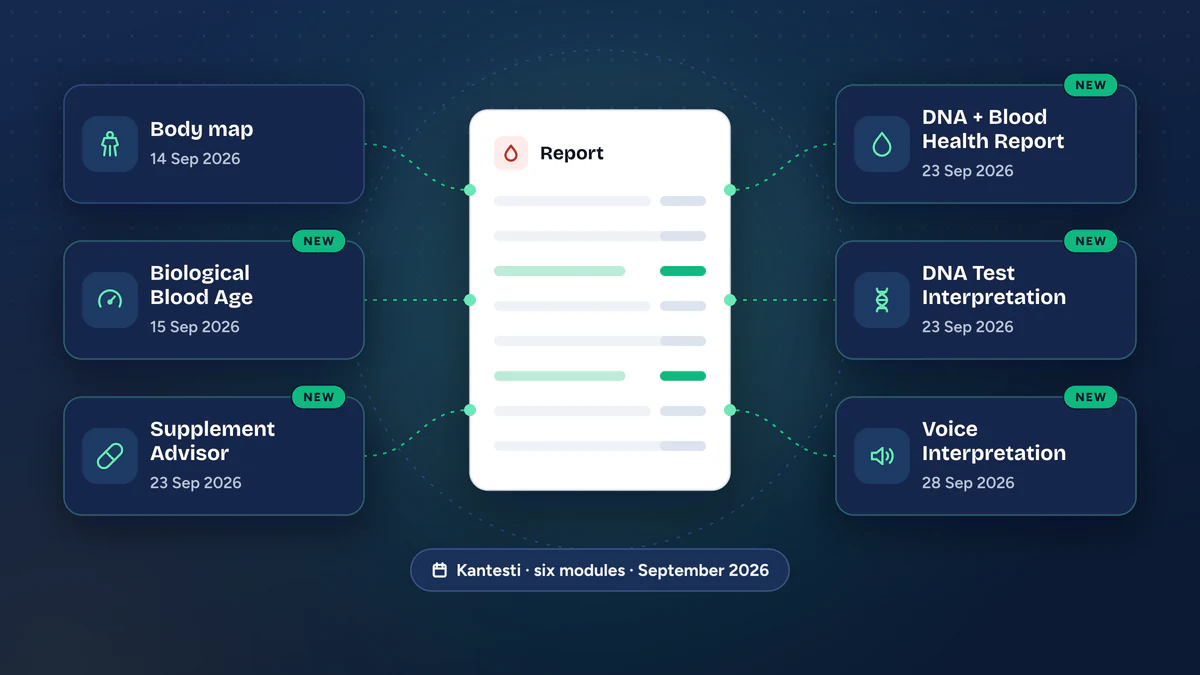
Between 14 and 28 September 2026 Kantesti shipped six modules that move it beyond reading a single blood test: it can now read DNA, combine DNA with blood results, suggest supplements, estimate a biological blood age, draw out-of-range values on a body map and read the interpretation aloud. This guide explains what each module does, who it is for, where its limits are and how it differs from asking a general chatbot.
Source: Kantesti “What’s New” log (2026) and the Kantesti DNA Hub page (updated 23 September 2026).
At a glance
Newest first. Each card jumps to the full section below; the table sums up who each module is for and what a general assistant can do instead.
Editorial disclosureWe openly recommend Kantesti, our Editor’s Choice. This guide describes the modules from Kantesti’s product information; read our editorial policy for how we work.
The AI interpretation in a Kantesti report can now be played as audio, read aloud in the report's language: the results in brief first, then what to do next, in about two minutes.
Source: Kantesti “What’s New” log, 28 Sep 2026
Upload a raw DNA file or an existing genetic report and get a genetic health report covering drug response, nutrient metabolism, carrier status and disease risks, in 100 languages.
Source: Kantesti “What’s New” log, 23 Sep 2026
Combines a patient's DNA report with an interpreted blood test into one summary that shows where genes and lab values agree and where they disagree.
Source: Kantesti “What’s New” log, 23 Sep 2026
Builds a personalised supplement plan from DNA, a blood test and a short questionnaire, using the products the clinic stocks.
Source: Kantesti “What’s New” log, 23 Sep 2026
Part of the blood test analysis and shown in reports: a biological age estimated from the panel, plus clinical ratios that a lab printout does not usually include.
Source: Kantesti “What’s New” log, 15 Sep 2026
Values outside the reference range are drawn on a human silhouette, with a legend naming the organ or system each one points to.
Source: Kantesti “What’s New” log, 14 Sep 2026
| Module | Date | What it does | For | What a general assistant can do |
|---|---|---|---|---|
| Voice Interpretation | Reads the report’s interpretation aloud: results first, then next steps, in about two minutes | Patients, clinics, labs | PartialGeneric voice mode reads any chat answer aloud | |
| DNA Test Interpretation | Genetic health report from a raw DNA file or a genetic report | Clinics, patients | PartialExplains pasted variants; no curated marker panel | |
| DNA + Blood Health Report | One summary of where genes and lab values agree or disagree | Clinics, patients | PartialFree-form joint summary on request | |
| Supplement Advisor | Supplement plan from DNA, blood test and a questionnaire, using the clinic’s products | Clinics, patients | PartialGeneral supplement discussion, no structured plan | |
| Biological Blood Age | A biological age read from the panel, plus extra clinical ratios | Patients, clinics, labs | PartialCan apply a published formula you supply | |
| Body map | Out-of-range values drawn on a body silhouette, by organ or system | Patients, clinics, labs | PartialCharts on request, no built-in body map |
Swipe sideways to see every column.
New
The AI interpretation in a Kantesti report can now be played as audio, read aloud in the report’s language: the results in brief first, then what to do next, in about two minutes.
Patients Clinics Labs
People with low vision, little time or limited confidence with medical terms, and clinics and labs that hand reports to patients.
You can listen to your results instead of working through a dense report. It narrates the report’s interpretation; it does not replace a consultation.
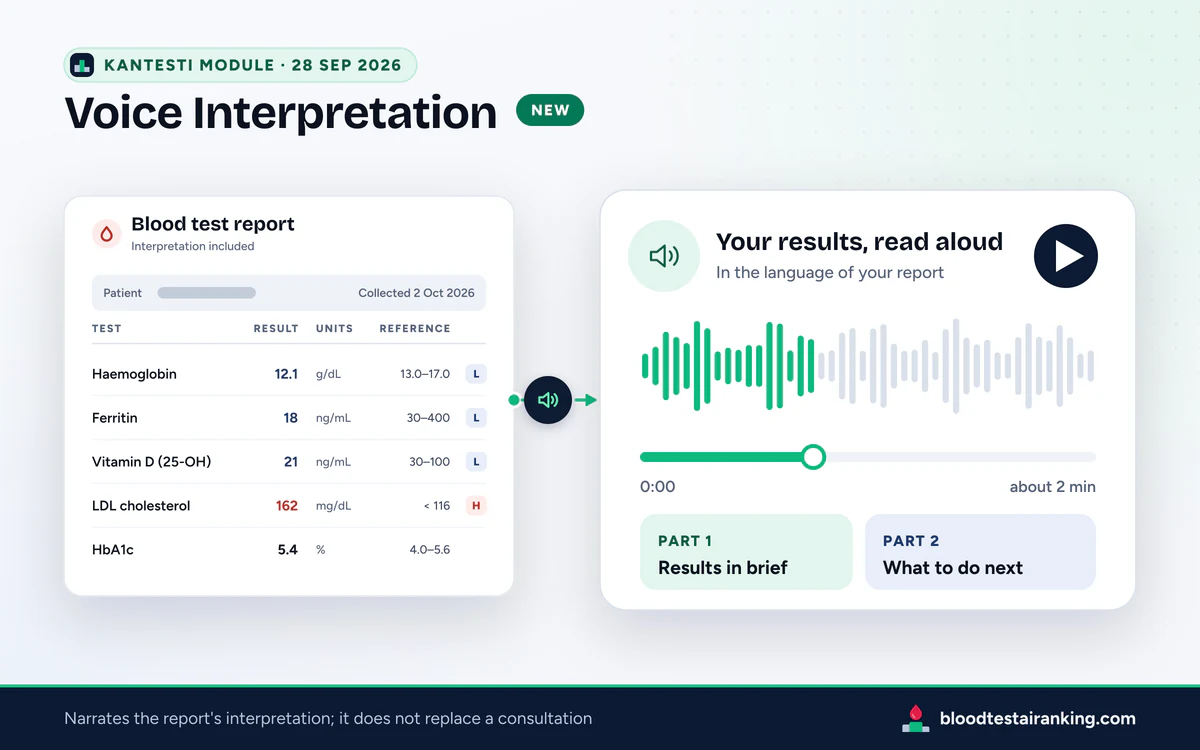
ChatGPT, Gemini, Claude and Perplexity can read an answer aloud or talk in a voice mode, but the spoken text is whatever the chat produced. Here the narration follows the structure of the lab report itself.
Audio repeats the written interpretation, so it inherits that interpretation’s limits. Urgent or unexpected results still need a call to your doctor, not just a listen.
New
Upload a raw DNA file or an existing genetic report and get a genetic health report covering drug response (pharmacogenomics), nutrient metabolism, disease risks, carrier status, traits, follow-up tests and red flags, written in more than 100 languages. It is the first module of the Kantesti DNA Hub for AI DNA test interpretation.
Raw data files from the major consumer DNA services are read directly, also when zipped: 23andMe, AncestryDNA, MyHeritage, FamilyTreeDNA (FTDNA) and LivingDNA, plus VCF files. A genetic report from any laboratory can be uploaded as up to 6 PDF, JPG or PNG files (photos of a printed report work), and rsID lines can be pasted in. Kantesti explains how to export the file from each service on its guide to downloading raw DNA data.
In the DNA Hub documentation we reviewed, the raw file is parsed on Kantesti’s server and matched to the curated 334-marker panel; an AI model then writes the findings, and every finding is checked against the uploaded file before the report is shown:
This file check is the main thing a general chatbot lacks: a chatbot can write a fluent genetic report about variants that are not in your file at all. Our news story on the DNA Hub launch looks at it in more detail.
Methylation and B vitamins · cardiovascular · lipids and cholesterol · metabolic and diabetes · weight and appetite · vitamins and minerals · food response · detoxification · inflammation and immunity · autoimmune (HLA tag markers) · pharmacogenomics (34 drug-response markers, including CYP2C19, CYP2D6 and SLCO1B1) · blood, iron and clotting · bone and joint · hormones · brain, mood and sleep · fitness and recovery · longevity and ageing · cancer predisposition (tag markers, always to be confirmed clinically) · carrier status (tag markers for recessive conditions) · traits (non-medical).
The method section of the DNA Hub names its references: markers are identified by their dbSNP rsIDs, drug-response phenotypes use the terminology of the Clinical Pharmacogenetics Implementation Consortium (CPIC) without giving prescription doses, and every finding is graded established, probable or preliminary. To see the format before a clinic adopts it, Kantesti publishes a sample genetic health report.
Clinics Patients
The DNA Hub is made for clinics: the clinician opens DNA Health in the Kantesti clinic panel, picks the patient and the report language, uploads the file and prints an A4 PDF with the clinic’s logo. Patients who already have consumer DNA data get a readable report instead of a raw file, through their clinician. Developers can use the same modules through the DNA Health API endpoints, with a sandbox and an async mode.
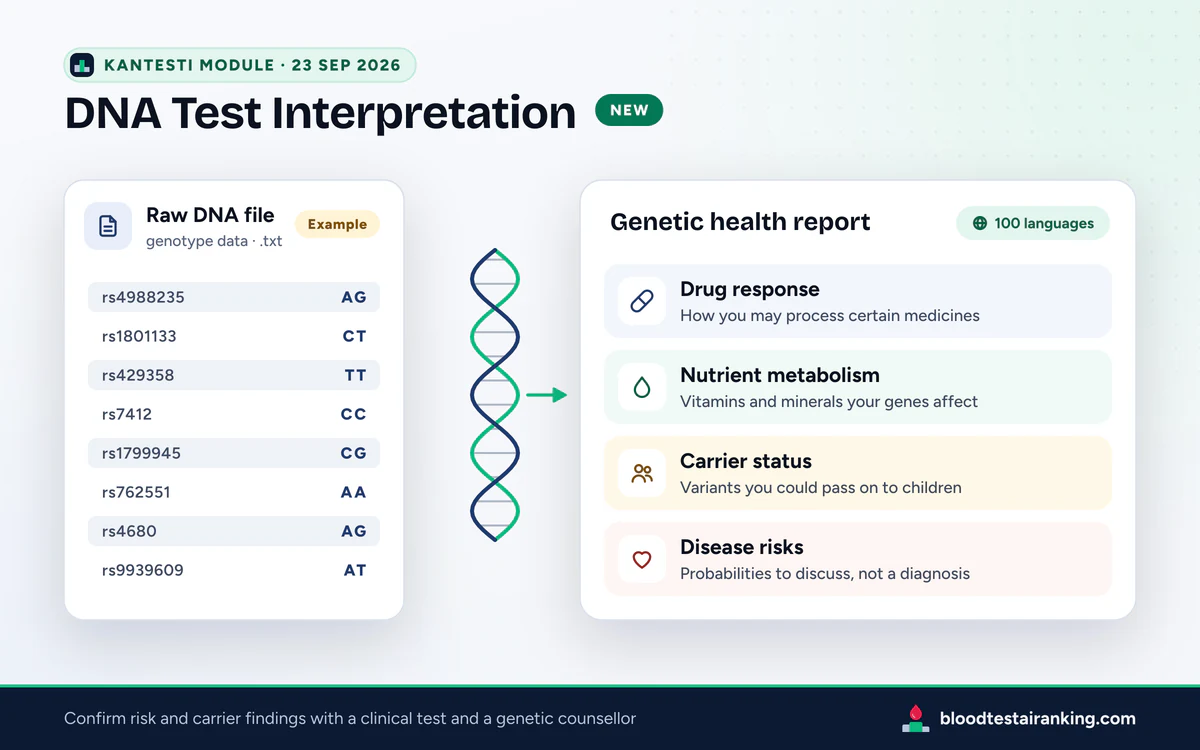
A general assistant can explain a variant you paste in, and some can parse a raw genotype file with their code tools. In our research we found no curated pharmacogenomic or carrier-screening pipeline behind them, and no check of the answer against your file, so their output is an ad-hoc reading, not a structured genetic report.
Decision support, not a diagnosisKantesti’s DNA test interpretation is clinical decision support for healthcare professionals: not a diagnosis and not a prescription. Consumer genotyping is not clinical sequencing. Consumer raw-data files can contain incorrect genotype calls, a genetic risk is a probability rather than a diagnosis, and actionable or carrier findings must be confirmed with validated clinical genetic testing and discussed with a doctor or genetic counsellor. Never change a medicine because of a drug-response finding without your prescriber.
New
Combines a patient’s DNA report with one of their interpreted blood tests into one summary that shows where a genetic finding and a lab value agree and where they disagree. The DNA and blood test report adds a risk matrix, priority actions and a monitoring plan.
Clinics Patients
Clinicians who already hold both results for a patient: in the clinic panel the DNA report sits in the same patient record as the blood tests, so combining them is one step.
Instead of two separate documents, patient and clinician see in one place whether a genetic tendency shows up in current lab values or not. Genes describe tendencies and blood values describe the present, so the combined view frames better questions rather than giving a diagnosis.
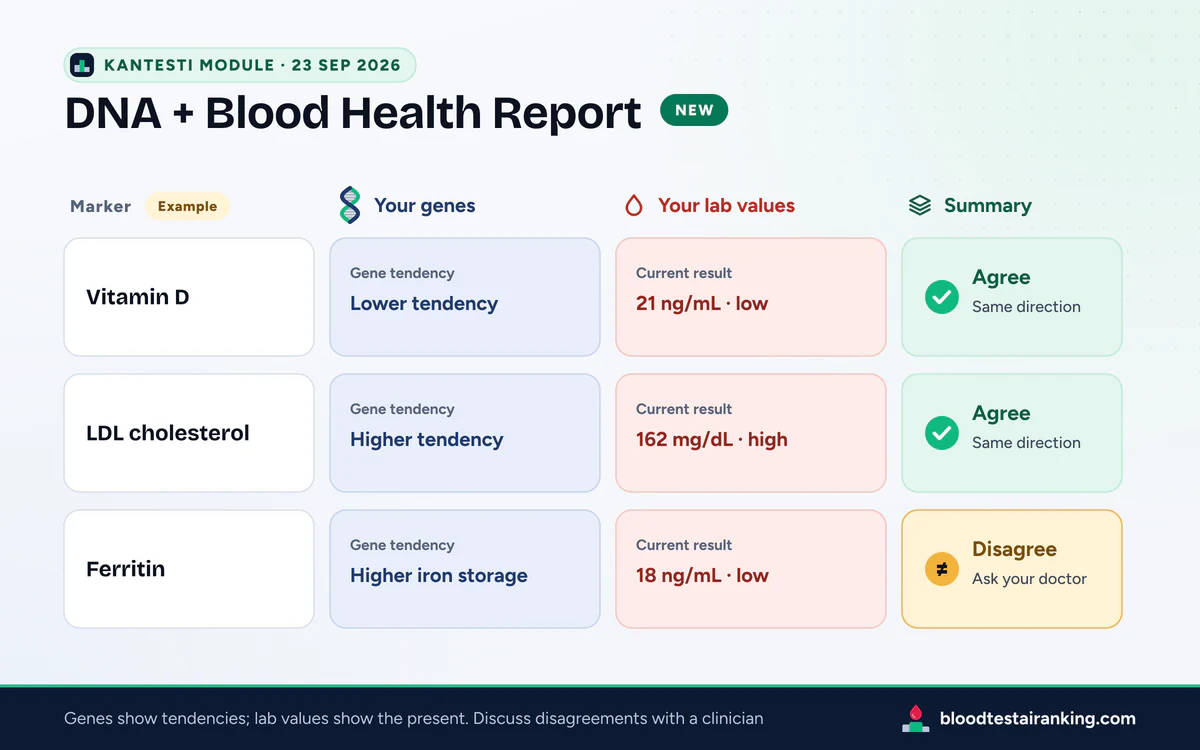
You can upload a genetic report and a blood test to a general assistant and ask for a joint summary, but the result is free-form text with no fixed structure showing agreement and disagreement, and nothing ties each genetic statement back to the file.
It is only as good as its two inputs: a raw-data error or an old blood test carries straight into the summary. Discuss any disagreement between genes and lab values with a clinician.
New
Builds a personalised supplement plan from DNA, a blood test and a short questionnaire, with doses, timing, interactions and re-test dates, using the products the clinic stocks. In the DNA supplement plan method we reviewed, doses stay within the tolerable upper intake levels published by health authorities (EFSA dietary reference values).
Clinics Patients
Clinics that want to offer a plan grounded in the patient’s own data instead of generic advice.
Because the plan draws on the clinic’s stock, ask whether alternatives exist, and check every supplement against your medicines and conditions with a doctor or pharmacist.
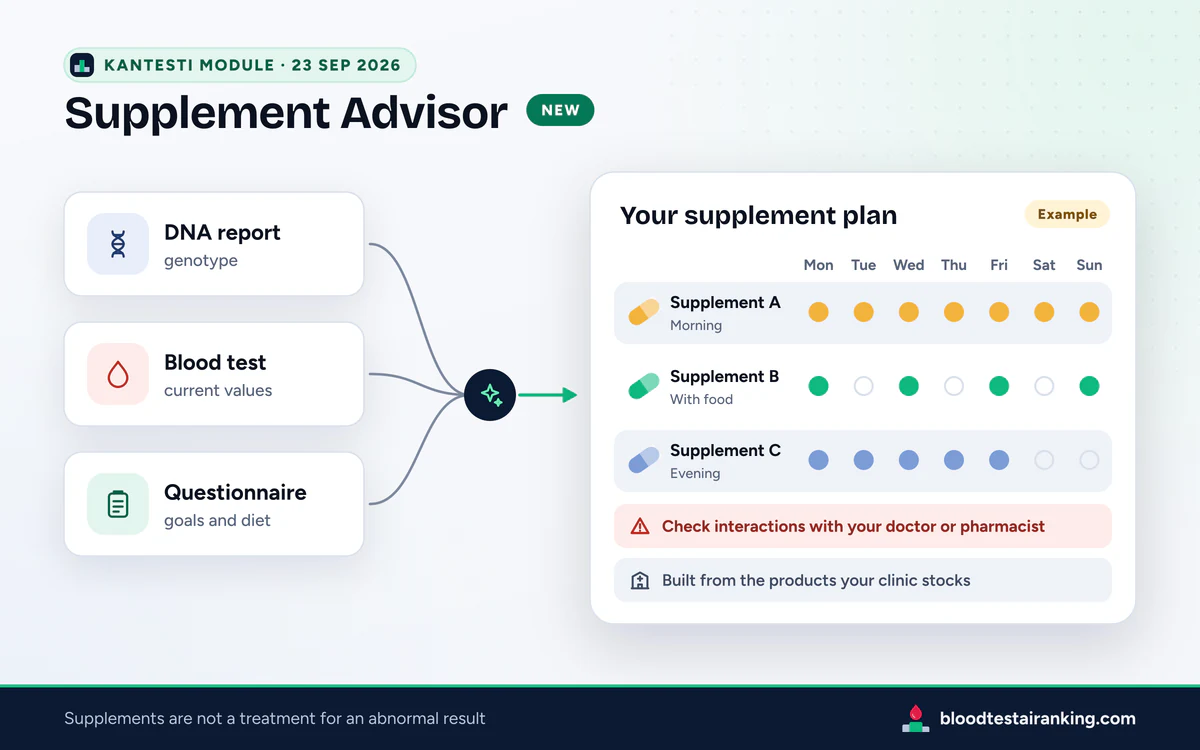
General assistants will discuss supplements in general terms when asked, and Perplexity can summarise published evidence with citations. They do not build a plan from DNA, blood and questionnaire data together, and they have no link to a clinic’s product range.
Supplements can interact with medicines and are not a treatment for an abnormal result. A plan tied to a clinic’s stock carries an obvious commercial interest, so it deserves a second opinion.
New
Part of the blood test analysis and shown in reports: a biological age estimated from the panel, plus clinical ratios that a lab printout does not usually include.
Patients Clinics Labs
Anyone who has repeat blood tests and wants one summary figure to follow, and clinicians who want the extra ratios without calculating them by hand.
You get a single summary figure to track and extra ratios to discuss with your doctor. Watch how it changes across tests rather than reacting to one result. We did not find the formula in the sources we reviewed.
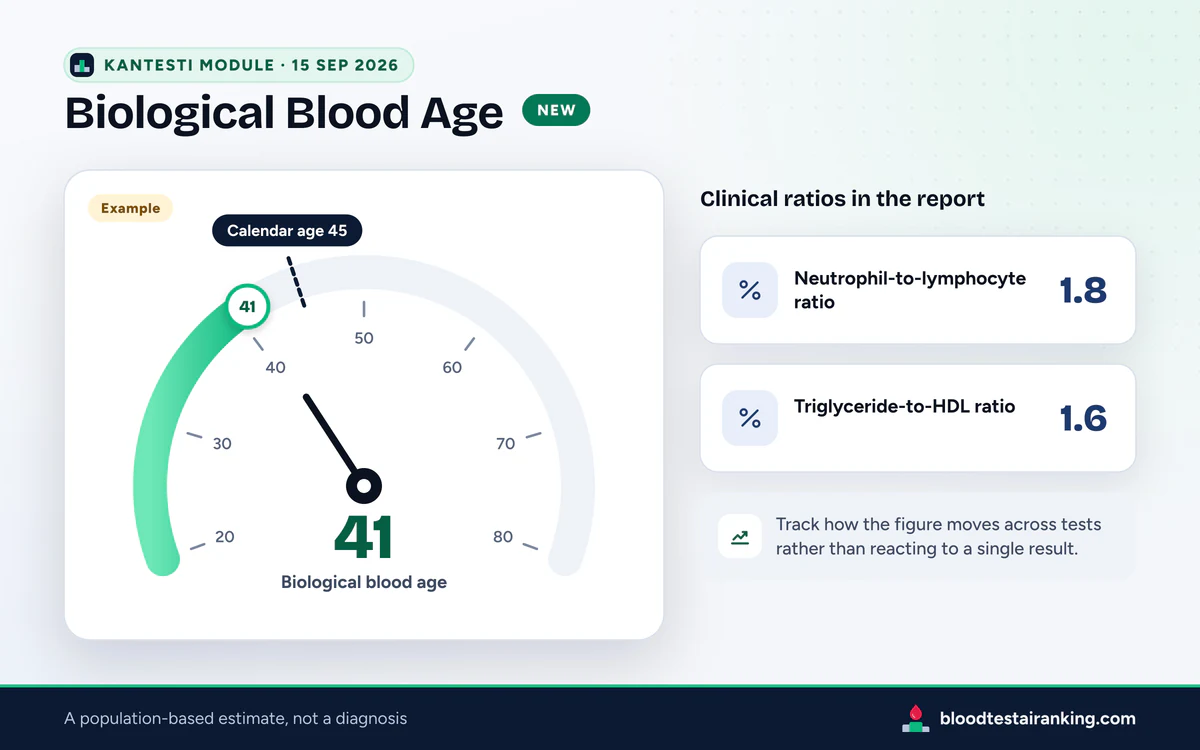
A general assistant can walk through a published blood-age formula if you give it the right inputs, but it is not a built-in feature, the choice of formula is up to the chat, and the arithmetic needs double-checking.
A biological-age estimate is a population-based model, not a diagnosis. It can move with a recent illness, hydration or lab-to-lab differences.
Update
Values outside the reference range are drawn on a human silhouette, with a legend naming the organ or system each one points to.
Patients Clinics Labs
Readers of long reports who want to see quickly which body systems their flagged values relate to.
You can see at a glance which body systems your out-of-range values relate to, which makes a long report easier to discuss with a clinician.
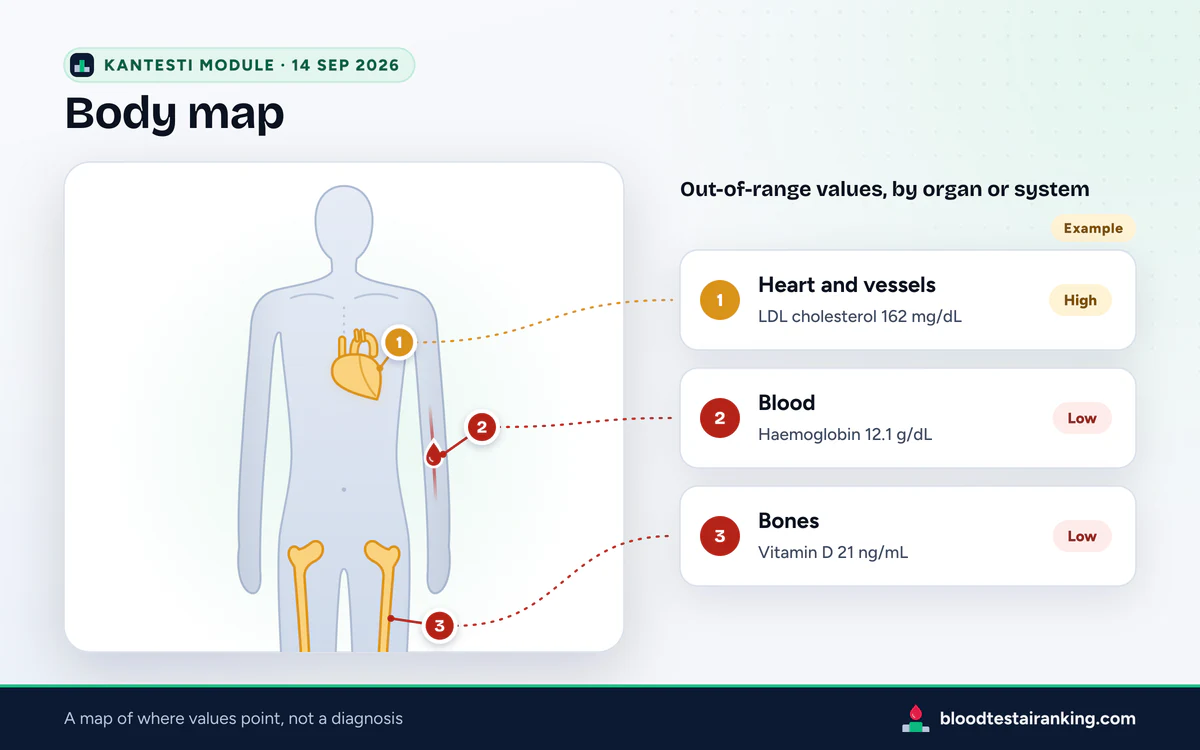
General assistants can draw a chart or diagram on request, but none we reviewed has a built-in body map tied to out-of-range values.
A marker linked to an organ on the map is a pointer for discussion, not evidence that the organ is diseased. Many values are affected by more than one system.
Our scores
Our method has a capability axis worth 16% of each score: 15 capabilities, counted as 1 for a dedicated feature (Yes), 0.5 for something you can approximate in a chat (Partial) and 0 when we found nothing (No). The six modules are six of those 15 rows.
Safety
Before you act on any moduleThese modules support a conversation with your clinician; they do not replace it.
If your report flags a critical value or you feel unwell, contact your doctor or emergency services now. The full checklist for using any AI on a blood test is on our home page safety guide.
FAQ
Five modules are new in September 2026: Voice Interpretation (28 September), DNA Test Interpretation, DNA + Blood Health Report and Supplement Advisor (all 23 September) and Biological Blood Age (15 September). The Body map (14 September) is an update to the blood test report.
Yes, through a clinic. DNA Test Interpretation reads raw data files from 23andMe, AncestryDNA, MyHeritage, FamilyTreeDNA and LivingDNA, VCF files (also zipped), pasted rsID lines, or a genetic report uploaded as up to 6 PDF, JPG or PNG files. It is built for clinics and is clinical decision support, not a diagnosis: consumer genotyping is not clinical sequencing, so actionable and carrier findings must be confirmed with validated clinical genetic testing.
It combines a patient’s DNA report with one of their interpreted blood tests in one summary that shows where a genetic finding and a lab value agree or disagree, with a risk matrix, priority actions and a monitoring plan. Genes describe tendencies and blood values describe the present, so it frames questions for a clinician rather than giving a diagnosis.
It is estimated from the blood panel as part of the Kantesti analysis and shown in the report, next to clinical ratios a lab printout does not usually include. We did not find the formula in the sources we reviewed. Treat it as a figure to follow across tests, not as a diagnosis: illness, hydration and lab-to-lab differences can move it.
Yes. Voice Interpretation reads the AI interpretation of a Kantesti report aloud in the report’s language: the results in brief first, then what to do next, in about two minutes. It narrates the written interpretation, so urgent or unexpected results still need a call to your doctor.
It builds plans from the products the clinic stocks, using DNA, a blood test and a short questionnaire, with doses, timing, interactions and re-test dates. Ask your clinic whether alternatives exist, and check every supplement against your medicines and conditions with a doctor or pharmacist.
Next steps
Editorial disclosurebloodtestairanking.com editorially supports Kantesti. Links to Kantesti are ordinary editorial links. Scores follow our published method.