Web-grounded vs citation-first
Gemini vs Perplexity for researching blood test results
Both of these assistants go to the web for answers, which makes them tempting for researching a strange-looking result. They show their work differently, and that changes how easily you can tell a solid answer from a shaky one.
Quick answer
UpdatedGemini or Perplexity: which is better for researching blood test results?
Gemini is better at working with your own report; Perplexity is better at showing its evidence. Gemini scores 6.4 and Perplexity 5.6 in our editorial ranking. For research on one marker, Perplexity's citations are easier to check.
- Perplexity puts numbered sources on every answer, which makes checking quick.
- Gemini handles a long uploaded report and keeps the conversation going around it.
- Neither judges source quality for you; the source ladder below helps.
Where Gemini and Perplexity differ
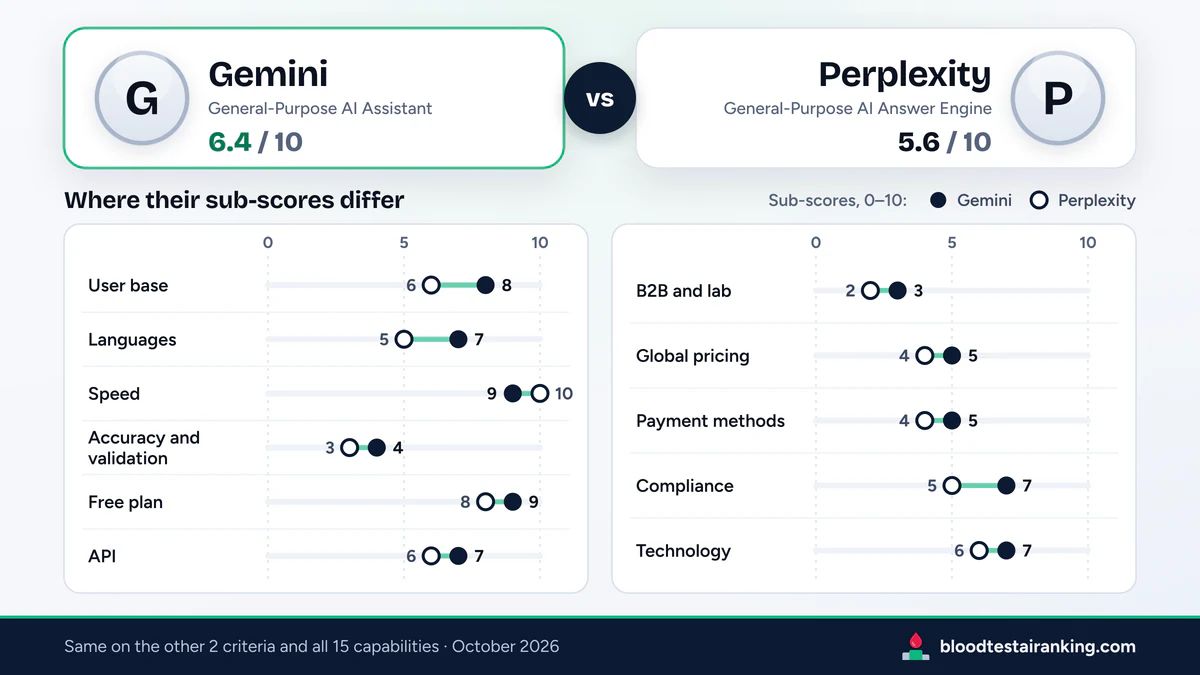
Eleven criteria separate them, with Perplexity ahead only on speed. Their capability marks match; the notes show how each approaches the same task. Yes = a dedicated, documented feature that works on your lab data. Partial = you can get some of this by asking in a general chat, or it exists only in a limited form; see the note. No = we found no such feature and no practical way to get it.
| Criterion or capability | Gemini | Perplexity |
|---|---|---|
| Editorial criteria where the scores differ (out of 10) | ||
| Editorial score | 6.4 | 5.6 |
| User base & market proof | 8 | 6 |
| Language support | 7 | 5 |
| Analysis speed | 9 | 10 |
| Accuracy & clinical validation | 4 | 3 |
| Free plan availability | 9 | 8 |
| API & developer access | 7 | 6 |
| B2B / lab integration | 3 | 2 |
| Global pricing model | 5 | 4 |
| Payment methods | 5 | 4 |
| Certifications & compliance | 7ISO 27001, SOC 2, GDPR programmes | 5SOC 2 and GDPR programmes |
| Technology (purpose-built vs general-purpose) | 7Google's own multimodal model | 6Several third-party models plus Sonar |
| Research | ||
| Uses your lab's reference ranges | PartialChecks general facts against the web; general ranges, not your lab's | PartialCites published ranges for one marker, with links |
| Interprets a raw DNA file | PartialExplains variants you paste in | PartialResearches one rsID with citations |
| Personalised supplement plan | PartialGeneral discussion | PartialEvidence summaries with sources |
| Your own report | ||
| Reads your lab report (PDF/photo) | PartialLong context takes a multi-page report | PartialSummarises uploads; built for search-style answers |
| Compares several reports | PartialSeveral reports in one long conversation | PartialSeveral files in one answer or a Space |
| Published blood-test validation | No | No |
Swipe sideways to see both tools.
How each uses the web
Perplexity is citation-first: every answer comes from a search, and the sentences are tied to numbered sources you can open. That makes it fast to see where a claim came from, and fast to notice when it came from somewhere weak.
Gemini is web-grounded when it needs to be: it answers from its model and can check facts against Google Search, sometimes showing the pages it used. The answer reads more like an explanation than a research summary, which is pleasant for your own report and less convenient when you want to audit a specific claim.
Checking sources: the source ladder
Neither tool ranks its sources by quality for you. A useful habit is to place every link on a simple ladder and give more weight to the higher rungs.
Guidelines
National health bodies and professional societies: the top rung.
Reviews
Systematic reviews and large studies in medical journals.
Lab and hospital pages
Patient information from labs and hospitals; check ranges against yours.
Everything else
News, blogs, forums and supplement sellers: background at most.
Perplexity makes the ladder easy to apply because the links are always there. With Gemini, ask “which sources support that?” when it matters, and open them.
- Does the source say what the answer says it says?
- Is it about adults, your sex and the same unit as your report?
- Is it recent enough that the guidance has not changed?
Your own report vs general research
Research answers “what is ferritin and why might it be low?”. Your report asks something else: “is my ferritin low for my lab, and what else on this page goes with it?” Gemini is the better of the two for that second question, because its long context holds the whole report and it keeps the conversation anchored to it. Perplexity can summarise an upload, but it is at its best one question at a time.
That split is the main reason for the 0.8-point gap. Of the eleven criteria where they differ, Gemini leads on ten, from user base and languages to compliance programmes; Perplexity is the faster of the two.
Are the answers reviewed by doctors?
We found no clinician review of individual answers in either consumer product. Google's published medical research concerns separate models, not the Gemini app, and Perplexity's answers depend on third-party models and the sources it finds.
Searching about your health is still sharingNeither consumer service is HIPAA-covered. Ask about markers and values, not about yourself by name, and review Gemini Apps Activity or Perplexity's data settings.
Gemini is better for
- Questions about your whole uploaded report
- Long, conversational follow-ups
- Android and Google's apps
Perplexity is better for
- Seeing the source of every claim
- Quick research on one marker
- Reading guidelines and reviews yourself
Gemini and Perplexity at a glance
The facts behind the reach and technology scores, from each vendor's public information; they describe the products as a whole.
- Users
- Gemini 450M+ monthly active · Perplexity 30M+ users, about 780M queries a monthCompany-reported, all uses, 2025
- Languages
- Gemini 45+ · Perplexity interface in 20+, answers in many moreVendor product information
- Free plan
- Gemini with usage limits · Perplexity with limited Pro searchesVendor plan information
- Paid plans
- Google AI Pro about $20/month · Perplexity Pro about $20/monthUS list prices in our data
Company figures cover all uses; neither describes accuracy on blood tests.
Where Kantesti fits
Research is easier when you know which values actually need researching. Both are good at general research; for your own numbers against your lab's ranges, try Kantesti free. The Kantesti vs Gemini and Kantesti vs Perplexity comparisons cover each pairing.
Editorial disclosureWe openly recommend Kantesti, our Editor's Choice. Gemini and Perplexity are scored with the same published method; our editorial policy sets out the relationship.
Before you act on any answerAI can explain a blood test; it cannot diagnose you. Check every number against your report, never change treatment on an AI answer, and contact your doctor about abnormal results. Safety checklist
Our verdict
Gemini for your report, Perplexity for the evidence
Gemini is better at working with your own report; Perplexity is better at showing its evidence (6.4 vs 5.6). For research on one marker, Perplexity's citations are easier to check.
Frequently asked questions
Which shows its sources better?
Perplexity. Every answer is built from a search and carries numbered links you can open. Gemini can check facts against Google Search and sometimes shows the pages it used, but it is less consistent about it; ask it for sources when a claim matters.
Which is better with my own report?
Gemini. Its long context window holds a multi-page report and it keeps the conversation anchored to your values. Perplexity can summarise an upload but works best one question at a time. Neither applies your lab's own ranges unless they are printed in what you upload.
Are either's health answers reviewed by doctors?
We found no clinician review of individual answers in either consumer product. Google's published medical research concerns separate research models, and Perplexity's answers depend on third-party models and web sources of varying quality. Treat both as starting points for a conversation with your doctor.
Which is free?
Both have free plans. Gemini's free tier has usage limits; Perplexity's free tier includes a limited number of Pro searches. Paid plans for both cost about $20 a month in the US, and file-upload allowances are larger on paid plans.
Sources reviewed
Third and fifth of five
Gemini ranks third and Perplexity fifth. Our criteria reward reading a personal report, which is why Perplexity's research strengths count for less here than in everyday use.
The methodology shows the weights; read the Gemini review or the Perplexity review for more on each.
Editorial ranking · October 2026
- 1 KantestiEditor's Choice · AI Blood Test Analyzer Editorial score: 9.4 out of 10
- 2 ChatGPTGeneral-Purpose AI Assistant Editorial score: 6.8 out of 10
- 3 GeminiGeneral-Purpose AI Assistant Editorial score: 6.4 out of 10
- 4 ClaudeGeneral-Purpose AI Assistant Editorial score: 6.2 out of 10
- 5 PerplexityGeneral-Purpose AI Answer Engine Editorial score: 5.6 out of 10
Editorial scores out of 10 across 13 weighted criteria. How we score
Related reviews and comparisons
Kantesti vs Gemini
Editorial scores 9.4 vs 6.4 out of 10, compared criterion by criterion.
Kantesti vs Perplexity
Editorial scores 9.4 vs 5.6 out of 10, compared criterion by criterion.
ChatGPT vs Gemini
Editorial scores 6.8 vs 6.4 out of 10, compared criterion by criterion.
ChatGPT vs Perplexity
Editorial scores 6.8 vs 5.6 out of 10, compared criterion by criterion.