Explain vs research
ChatGPT vs Perplexity: explaining your results vs researching them
ChatGPT is built to talk with you about your numbers; Perplexity is built to look things up and show you where it found them. Both will answer a blood test question, but they fail in different ways, and knowing how is the most useful thing on this page.
Quick answer
UpdatedChatGPT or Perplexity: which is better for blood test questions?
ChatGPT explains your own numbers better; Perplexity shows you the sources. ChatGPT scores 6.8 and Perplexity 5.6 in our editorial ranking. Use Perplexity to check a claim and ChatGPT to put it in plain words.
- Your whole report and follow-up questions: ChatGPT.
- One marker, with links to guidelines and reviews you can open: Perplexity.
- Neither is validated for reading lab reports; see a purpose-built analyzer for that job.
Where ChatGPT and Perplexity differ
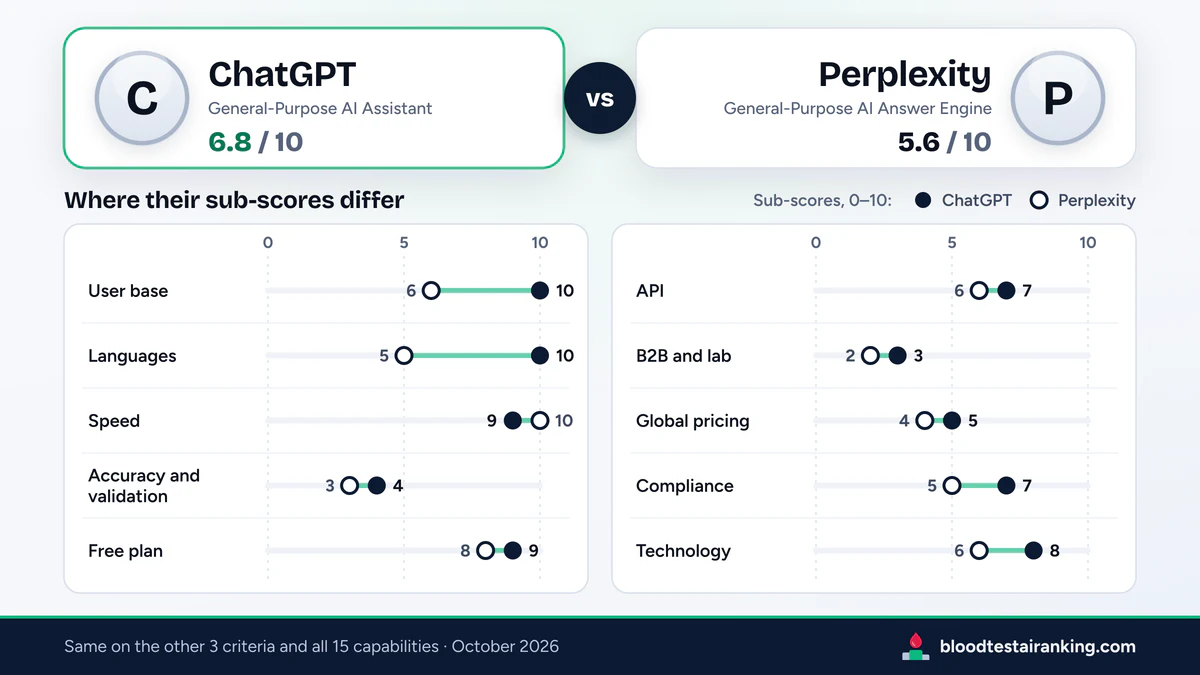
Ten of our 13 criteria separate them; Perplexity leads only on speed. Their capability marks match, so the notes show how each one works. Yes = a dedicated, documented feature that works on your lab data. Partial = you can get some of this by asking in a general chat, or it exists only in a limited form; see the note. No = we found no such feature and no practical way to get it.
| Criterion or capability | ChatGPT | Perplexity |
|---|---|---|
| Editorial criteria where the scores differ (out of 10) | ||
| Editorial score | 6.8 | 5.6 |
| User base & market proof | 10 | 6 |
| Language support | 1095+ languages | 5Interface in 20+ languages |
| Analysis speed | 9 | 10Fastest of the five tools we rate |
| Accuracy & clinical validation | 4 | 3 |
| Free plan availability | 9 | 8 |
| API & developer access | 7 | 6 |
| B2B / lab integration | 3 | 2 |
| Global pricing model | 5 | 4 |
| Certifications & compliance | 7SOC 2 Type 2, GDPR, CCPA programmes | 5SOC 2 and GDPR programmes |
| Technology (purpose-built vs general-purpose) | 8 | 6 |
| Your report | ||
| Reads your lab report (PDF/photo) | PartialBuilt for document conversations; reads and explains the whole file | PartialAccepts uploads (more on Pro); answers in search style |
| Uses your lab's reference ranges | PartialUses printed ranges; may supply a general one without saying so | PartialCites published ranges, which may not be your lab's |
| Research | ||
| Interprets a raw DNA file | PartialData tools can parse the whole file on request | PartialGood for one rsID with citations; not for a whole file |
| Personalised supplement plan | PartialGeneral discussion | PartialCited evidence summaries for one supplement |
| Biological blood age | PartialCan apply a formula to your inputs | PartialCan explain and cite published formulas |
| Trust | ||
| Published blood-test validation | No | NoDepends on third-party models and web sources |
Swipe sideways to see both tools.
Two kinds of answers
Ask “my ALT is 62, what does that mean?” and the two tools reply differently. ChatGPT answers like a patient tutor: what ALT is, what a mild rise often reflects, what might be checked next, and an offer to look at the rest of your report. Perplexity answers like a research assistant: a compact summary with numbered links to the pages it drew on, and suggestions for related questions.
For your own report, the tutor is more useful, which is a large part of why ChatGPT scores 1.2 points higher. For checking whether a statement is supported, the research assistant is better, because you can open the source and read it yourself.
How each goes wrong
ChatGPT: the invented range
When your report's ranges do not reach the chat, ChatGPT may supply a typical range from general knowledge and carry on, often without flagging that it did. The range may be fine for many adults and wrong for your lab, your age or your sex. The explanation built on it then sounds just as confident.
Perplexity: the misread source
Perplexity's failure is quieter. A real source can be summarised too strongly, two sources can be merged into a claim neither makes, or a page about a different population can be cited for yours. The link makes the answer look checked even when nobody checked it.
- With ChatGPT, ask which range it used for each flagged value and compare it with your report.
- With Perplexity, open the link and find the sentence that supports the claim.
- With both, treat anything that would change your treatment as a question for your doctor.
A two-step routine: research with sources, then explain
You do not have to choose. For a single marker that worries you, the two tools work well in sequence, and the order matters: evidence first, explanation second, so the explanation is anchored to something you have read.
Ask Perplexity
“What do guidelines say about a mildly raised ALT in adults?” Open the two strongest sources.
Ask ChatGPT
Paste your value, your lab's range and the key points, and ask for a plain explanation and questions for your doctor.
Check and bring
Compare the numbers with your report and take the questions to your appointment.
Keep identifiers out of bothNeither consumer service is HIPAA-covered. Paste values and ranges, not the whole report with your name and patient numbers, and check each product's data and training settings.
ChatGPT is the better choice for
- Walking through a whole report
- Follow-up questions in plain language, by text or voice
- Preparing for an appointment
Perplexity is the better choice for
- Checking what the evidence says about one marker
- Finding guidelines and reviews to read yourself
- Fast answers when you only need a definition
How they are built
The product facts behind the technology and speed scores, from each vendor's public information. They describe the products in general, not their use for blood tests.
- Underlying models
- ChatGPT: OpenAI's own GPT models · Perplexity: several frontier models plus its in-house Sonar modelsVendor product information
- Web sources
- ChatGPT: can search when needed · Perplexity: every answer grounded in search, with numbered citationsVendor product information
- Users
- ChatGPT 800M+ weekly active · Perplexity 30M+ users, about 780M queries a monthCompany-reported, all uses, 2025
- File uploads
- ChatGPT: free and paid plans, higher limits on Plus · Perplexity: more on ProVendor plan information
Vendor figures are company-reported and cover all uses; they say nothing about accuracy on blood tests.
Where Kantesti fits
Research and conversation both start from your numbers, so the numbers need to be right. Before you research or chat, get a structured reading of the whole report; Kantesti's first report is free. Our Kantesti vs ChatGPT and Kantesti vs Perplexity pages show how each assistant pairs with it.
Editorial disclosureWe openly recommend Kantesti. ChatGPT and Perplexity are scored on the same published criteria and weights; our editorial policy explains the relationship.
Before you act on any answerAI can explain a blood test; it cannot diagnose you. Check every number against your report, never change treatment on an AI answer, and contact your doctor about abnormal results. Safety checklist
Our verdict
ChatGPT to explain, Perplexity to check
ChatGPT explains your own numbers better; Perplexity shows you the sources (6.8 vs 5.6). Use Perplexity to check a claim and ChatGPT to put it in plain words.
Frequently asked questions
Is Perplexity more accurate than ChatGPT for health?
Not in our scoring: ChatGPT scores 4 and Perplexity 3 on accuracy and clinical validation, and neither has published validation for reading blood tests. Perplexity's citations make its claims easier to check, which is different from being more accurate; summaries of real sources can still be wrong.
Which should I use for a single marker?
Perplexity, if you want to see what guidelines and reviews say and read them yourself. ChatGPT, if you want that marker explained in the context of the rest of your report. Many people get the best result by doing both, in that order.
Can Perplexity read my PDF?
Yes, it accepts file uploads, with more allowance on its Pro plan, and it can summarise a lab report. It is designed for search-style answers rather than full report analysis, so for walking through a whole report ChatGPT is the better general assistant, and a purpose-built analyzer is better still.
Do citations make an answer safe?
No. A citation shows where a claim came from, not whether it was summarised correctly or applies to you. Open the source, check the sentence and the population it describes, and discuss anything that affects treatment with your doctor.
Sources reviewed
Second and fifth of five
ChatGPT ranks second and Perplexity fifth. The 1.2-point gap is the widest between any two assistants we rate, because our criteria weigh reading your report over researching a topic.
See the methodology for the weights, or read the Perplexity review and the ChatGPT review.
Editorial ranking · October 2026
- 1 KantestiEditor's Choice · AI Blood Test Analyzer Editorial score: 9.4 out of 10
- 2 ChatGPTGeneral-Purpose AI Assistant Editorial score: 6.8 out of 10
- 3 GeminiGeneral-Purpose AI Assistant Editorial score: 6.4 out of 10
- 4 ClaudeGeneral-Purpose AI Assistant Editorial score: 6.2 out of 10
- 5 PerplexityGeneral-Purpose AI Answer Engine Editorial score: 5.6 out of 10
Editorial scores out of 10 across 13 weighted criteria. How we score
Related reviews and comparisons
Kantesti vs ChatGPT
Editorial scores 9.4 vs 6.8 out of 10, compared criterion by criterion.
Kantesti vs Perplexity
Editorial scores 9.4 vs 5.6 out of 10, compared criterion by criterion.
ChatGPT vs Gemini
Editorial scores 6.8 vs 6.4 out of 10, compared criterion by criterion.
ChatGPT vs Claude
Editorial scores 6.8 vs 6.2 out of 10, compared criterion by criterion.